LexiSharp
A composable information retrieval toolkit for .NET — an in-memory inverted index, four ranking strategies, rank fusion, reranking, optional PostgreSQL backends, and model-agnostic seams for dense, learned-sparse and neural scoring. The models stay in your application; the core package references no NuGet package at all.
dotnet add package LexiSharp
using LexiSharp.Core;
using LexiSharp.Indexing;
using LexiSharp.Ranking;

ITextSearchEngine engine = new RankedTextSearchEngine(
    new InMemoryTextIndex(),
    new Bm25Scorer());

engine.Index(new[]
{
    new SearchDocument("1", "The search engine uses BM25 to rank the results"),
    new SearchDocument("2", "TF-IDF is a classic method of textual search"),
    new SearchDocument("3", "Italian cuisine is renowned in Rome"),
});

foreach (var result in engine.Search("textual search"))
    Console.WriteLine($"{result.DocumentId} - {result.Score:0.###}: {result.Document.Text}");
net10.0, MIT. Optional packages: LexiSharp.MessagePack (binary index persistence), LexiSharp.AspNetCore (a GET /search endpoint), LexiSharp.Postgres (lexical, vector, sparse, fuzzy and true BM25 backends).
See it running
dotnet run --project samples/LexiSharp.Demo
# → http://localhost:5000
Five retrieval strategies over one corpus, compared live — plain BM25, corpus-derived semantic expansion, dense hashing embeddings, reciprocal-rank fusion and a term-overlap rerank — with per-lane latency, highlighting and a click-through “why did this rank here?” panel. No model, no external service.
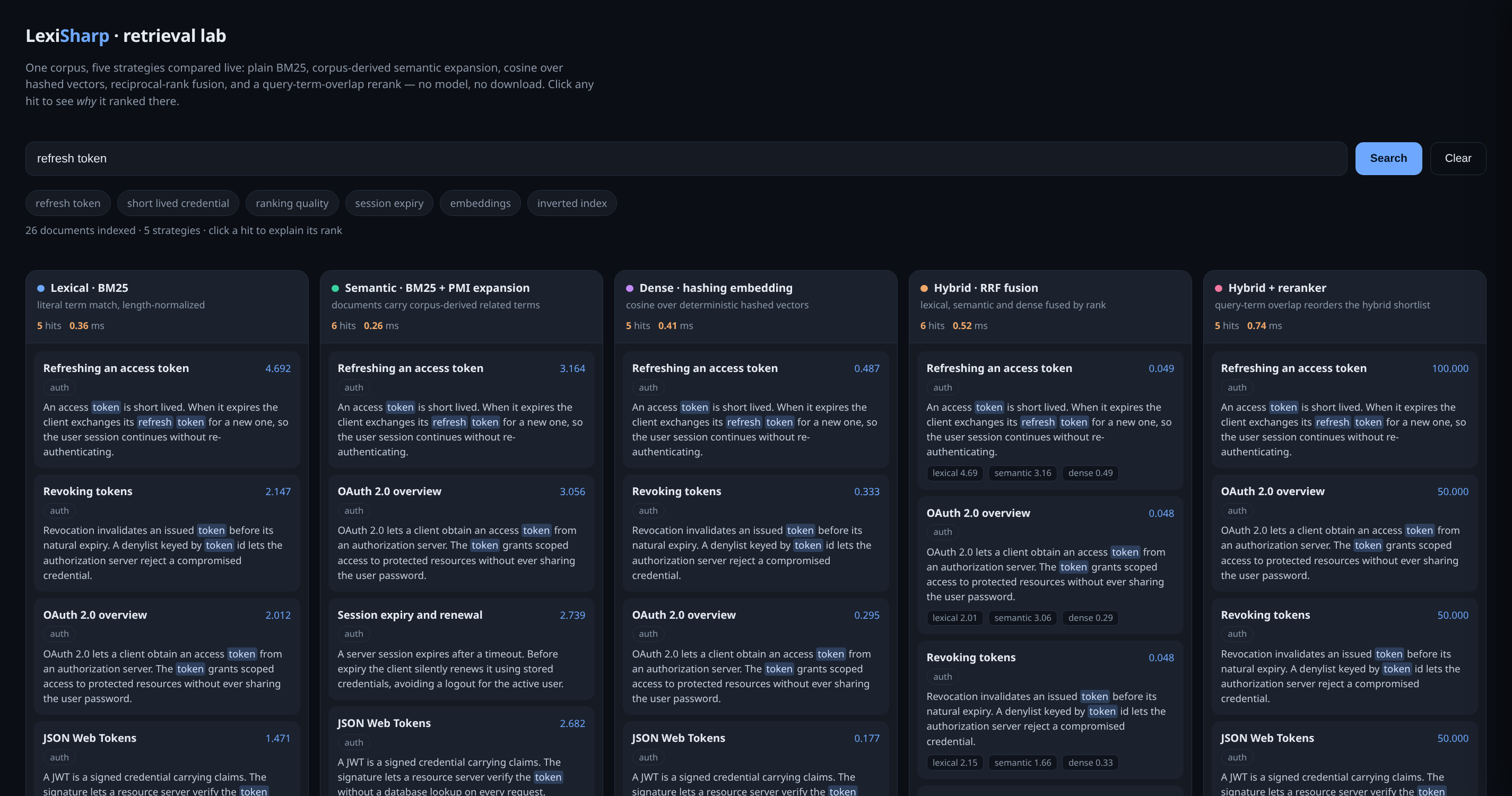
Clicking a hit also shows the SearchTrace chain for that document — the stages it passed through and the score going in and out of each:
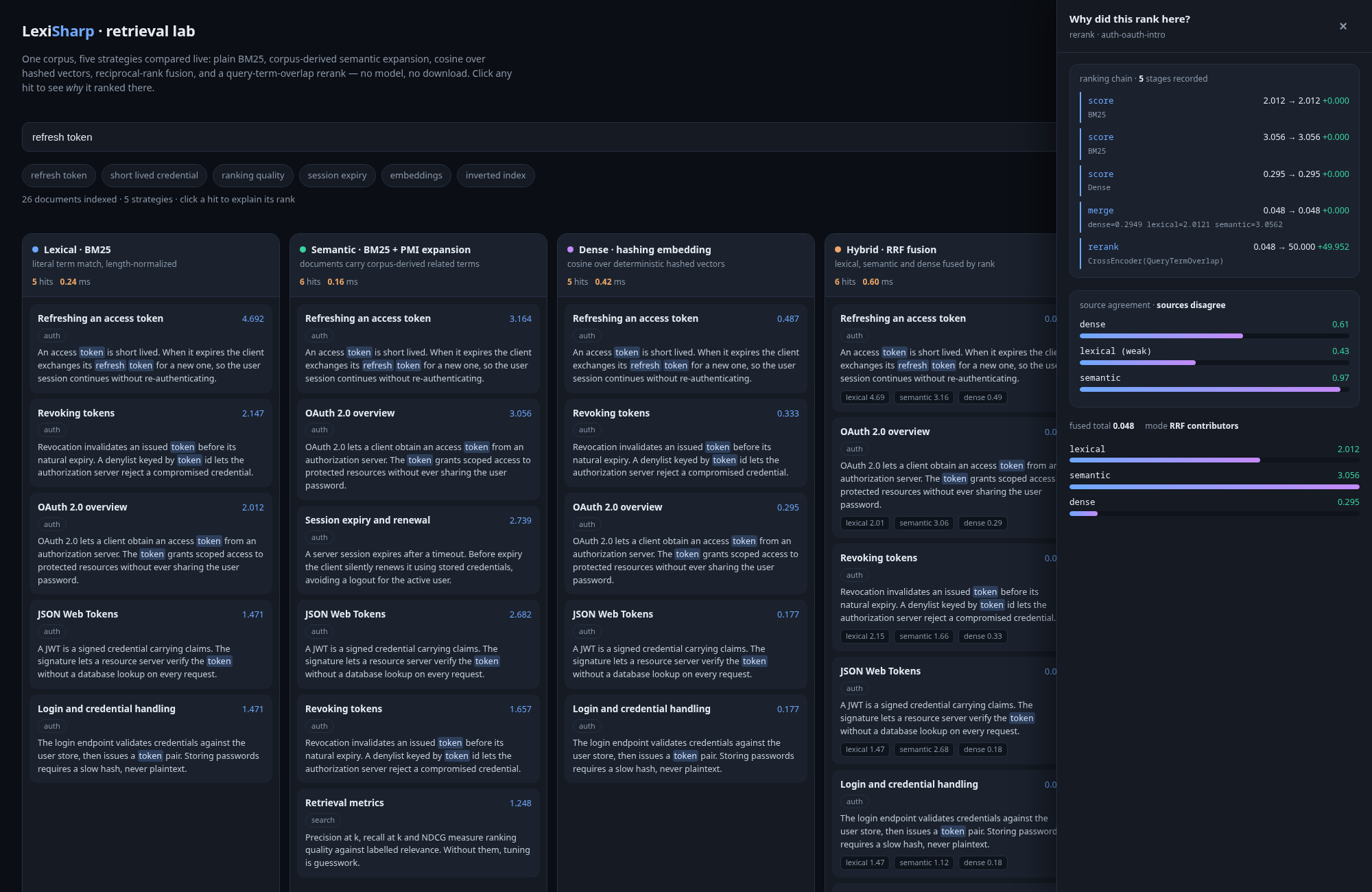
score   4.6925 -> 4.6925  BM25
score   3.1642 -> 3.1642  BM25
score   0.4867 -> 0.4867  Dense
merge   0.0492 -> 0.0492  dense=0.4867 lexical=4.6925 semantic=3.1642
rerank  0.0492 -> 100     CrossEncoder(QueryTermOverlap)
Each lane states what backs it — the semantic lane uses PmiTermExpander, the dense lane a HashingEmbeddingProvider, the rerank lane a local term-overlap ICrossEncoderScorer — and all three are swappable for a real model behind their existing seam. See Reference demo for the wiring.
Want evidence rather than a demo? The same engines are scored on NFCorpus, SciFact and ArguAna against BEIR’s published BM25 numbers in the eval harness, which you can run yourself.
What is measured, and what is not
Stated up front, because a library that only quotes its good numbers is not worth reading twice. Every figure below is reproducible with a command on the Evaluation page.
- Against published baselines. On three public BEIR corpora, with the analysis, the BM25 parameters and the metric convention aligned to those the reference figures were produced with, the plain BM25 scorer reaches nDCG@10 0.3215 on NFCorpus and 0.6788 on SciFact, against 0.3218 / 0.6789 — equal to the fourth decimal. On ArguAna, at the reference’s own k1=0.9/b=0.4, it reaches 0.3970 against 0.3970, and recall@100 0.9324 against 0.9324;
trec_evalreads both off a run this harness writes, so neither figure rests on this repository’s metric code. Under the library’s own defaults the same scorer reads 0.308 / 0.662 / 0.320; that difference is the configuration, not the ranking. The corpora are md5-verified on download, the harness ships no licence over them, and every number here is pinned and re-checked by thePinned referenceworkflow. - A claim withdrawn before it was published. An earlier figure on ArguAna is not reproducible by any code path in this repository, and no release carried it; the measurement behind the withdrawal is in evaluation, the provenance in the changelog.
- Where the composed stack pays off. On NFCorpus — the one corpus where every lane is measured — a dense retriever alone lands at BM25 level (0.304), BM25+dense RRF fusion reaches 0.333, and adding a cross-encoder rerank 0.346, about 2.1 points above BEIR’s BM25. Those two lanes are the only ones that use a real model, and the model comes from the harness, not from the library.
- Zero runtime dependencies in the core.
LexiSharpreferences no NuGet package at all: index, BM25, every scorer and every decorator are BCL only. The optional packages bring their own. - Behaviour is specified by tests. Everything documented here is covered by the xUnit suite; the Postgres and ParadeDB integration tests run against a live instance on every build and self-skip when
POSTGRES_TEST_CONNECTIONis unset. - Not measured, and named rather than glossed over. The time cost of
SearchTrace(its allocation is pinned; the timing was not resolvable on the machine used, so no figure is quoted). The retrieval quality of the SQL backends — the BEIR harness runs the in-memory engines. The learned-sparse and expansion lanes on BEIR: no SPLADE model is wired into the harness, and corpus-derived expansion is a loss where it has been measured (0.8469 against BM25’s 0.8751 on the reference corpus). Not every combination of engine, scorer, reranker and merger is exercised by a test.
Where to go next
| Page | What is in it |
|---|---|
| Getting started | the engine in three lines, the typed LexiSharpIndex<T> facade, document loaders, an ASP.NET Core endpoint, the demo app |
| Building an inverted index | the inverted index and its statistics, named text fields, the tokenizer and stemming, binary persistence |
| Querying: filters, facets, highlighting | metadata filters, pagination, phrase queries, highlighting, prefix & fuzzy terms, synonyms, facets, the span-first API |
| BM25 and ranking functions | four scorers, BM25+ / BM25L and their δ tuners, BM25F, score boosting, proximity, per-term explanations — each with the measurement behind it |
| Rerankers and hybrid search | rerankers (MMR, cascade, cross-encoder, MaxSim), hybrid federation, cost-based and intent-based routing |
| Dense, sparse and query expansion | dense, learned-sparse and corpus-derived expansion, all behind consumer-supplied seams |
| Classification and text analysis | lexical similarity, keyword extraction, Naive Bayes classification |
| PostgreSQL and ParadeDB backends | PostgreSQL lexical / vector / sparse / fuzzy, ParadeDB BM25, what the integration tests cover |
| Search traces and telemetry | SearchTrace, production telemetry, source agreement, calibrated score confidence |
| Retrieval quality and IR metrics | the BEIR numbers in full, IR metrics, the benchmark CLI, per-query diffs, parameter tuning |
| Allocation and latency benchmarks | allocations and timings, with the machine they came from and the command to reproduce them |
| Reference | packages, architecture, scoring conventions, scope and limits, build and test |
| SPLADE: learned sparse retrieval | writing a consumer-side ISparseEmbeddingProvider around a SPLADE ONNX model |
| API reference | every public type of the four packages, generated from the assemblies — the contracts you implement, and the classes that implement them |
Scope
Version 0.6.0, one maintainer, and the public API may still change between minor versions — pin a version and read the release notes. The techniques implemented (BM25 and its variants, RRF, SPLADE-style sparse retrieval, MaxSim) follow published information-retrieval literature; what is here is a small, dependency-free .NET implementation of them, not new research. Full scope and limits.
All projects · Source on GitHub · NuGet · MIT